Showing posts with label Culture and sport. Show all posts

Thursday, September 9, 2010

Kongsi Raya

By: Manggis, 10-Sep-2010

Assalamualaikum

Shalom Aleichem

To the bloggers whoever you are, of whatever faith you are and to the faithless.

Today 9th September, the Jews are celebrating their Rosh Hashanah; therefore I would like to wish Happy New Year or Shana Tova Umetukah to the Jewish community all over the world including the few remaining Jews in Malaysia.

But tomorrow is the end of Ramadan 10th September, and I would like to greet the Muslims Eid Mubarak and may Allah accepted your fasting and give you barakah.

Being a multi-religious, multi-cultural country, Malaysians are used to sharing celebrations and festivals. This phenomenon is called Kongsi Raya. The word “kongsi”, is perhaps a Chinese word (D, please verify), which means “sharing”. Malaysians started to notice this many years ago when Hari Raya (the end of Ramadan celebration) was shared with the Chinese New Year. For the Chinese, the greeting is “Kong Si Fat Chai”, so in Malaysia we turned this term to become “Kongsi Raya” to signify the sharing of this Chinese New Year festival with Hari Raya.

Kongsi Raya is very rich and jovial festivals since the Malays and the Chinese will have their Big Makan (feast) almost at the same time. For both the Chinese and Malay communities, festivals means feast. It also means, visiting each other. For the Chinese the Big Feast is celebrated with their family on the eve of the festival followed by gambling sessions with family members and friends. Gambling in Chinese festival is almost a must. It’s significant and important to the Chinese culture because Chinese largely think, life is a gamble. To succeed, one needs a kind of gamble to take risk, to try new things and to explore the unknown. Gambling sessions is a practise to be bold to control one own destiny by chance.

While for the Muslims the feast is celebrated differently with their families after the Shalat (prayer) Eid-ul-Fitr, which will be mid-morning. But for Muslims, especially in Malaysia (not elsewhere, I think), prior to the feast is a special time, i.e. the time for the ritual of “forgiving and forgetting”. During this ritual, the younger family members will ask forgiveness from the elders, i.e. children to their parents etc... This is a special bonding event where the children will kiss the hands of the elders; this is the time when the elders will feel most appreciated, despite their children being distance, either physically or emotionally. They will recalled for any differences and ask for forgiveness, and make “halal” of whatever they (the younger ones) have taken either knowingly or unknowingly. This is the moment, when bad relationships are mended between relatives and friends. Our usual greetings to each other are:


Selamat Hari Raya, Maaf Zahir dan Batin, Halalkan Makan dan Minum.

“Maaf Zahir dan Batin” means, forgive me for all the wrongs that I have done outwardly or internally.

In the Muslim family household, this event of forgiving and forgetting is so special and sweet that no family members would wish to be alone during hari raya. They would almost feel like outcasts if they have no family homes to go to. Where ever they are, they would wish to come home to see their father and mother during this period. Since most elders live in the villages, big cities in Malaysia would be like ghost towns and empty during the festival, for the city dwellers would certainly return home to visit their elders. For those who really cannot go home, they will try to reach home, these days via telephone or other means of communications. For Malaysian Malays overseas, this moment will be celebrated by big gatherings. No one, really want to be alone during this period.

In addition, for the Muslims, this period is also celebrated by giving away alms and charity (sedekah). The compulsory alms (zakat fitrah), must be paid before the prayer Eid-ul-Fitr, the amount paid is equivalent to a day meal for yourself. Malaysia has numerous well organised alms collection centres throughout the country and will re-distribute the collection to the poor and needy. In addition, during this period, most people will perform their 4th Muslim ritual of giving alms (zakat) due to their wealth. This is a Muslim form of taxation. Remember, non-Muslim do not pay zakat. It is not obligatory for them to perform this. For all Malaysians (Mulsims and non-Muslims) they pay the normal income tax. In addition for Muslims, they must pay their obligatory alms. So Muslims pay double taxation. In order to adjust for this “slight injustice”, the Government allows, for Muslims to claim tax rebate for the alms paid.

Sometimes, I heard accusation that non-Muslims pay jizyah in the Muslim world, this is not true especially in Malaysia, Muslims pays double taxation. I pay double taxation. But I am a happy tax payer and am proud that I contribute to my community.

Many delicious cookies are made or purchased during hariraya; some are traditional while many are being created to suit the time and modernity. For example, many cookies these days are made from cornflakes, chocolates, nuts and other ingredients imported from the western cultures. Many people make a lot of money for making these cookies for sale “Hari raya cookies making “ is now a well-known, once a year business enterprise. My own favourite cookies are the pineapple tarts.

Eid-ul-Fitr is celebrated in a very grand (raya) way in Malaysia and that is why it is called hari raya. This is the day when you must wear your best cloth, usually new ones. In old days, only during hari raya that you get a change of clothing. So usually, my parents will give me two new clothes which will last me for the whole year. So of course this is also a flourishing business time for tailors and dress makers. As our economic position is improving a lot, it is not uncommon, for the tailoring business to accept orders one year in advance, i.e. as soon as hari raya ends, the tailor would receive new orders for the next year raya celebration.

For children, eid-ul- fitr is also magical and important. Apart from the celebration means they can play with fire crackers, it is also time for them to have as many cookies as possible. In addition, they will receive money. This is what children look forward to, since during hari raya, they will be able to collect some extra pocket money, from “duit raya”. During my childhood days of duit raya for the Malays ranges from 5 sen to one ringgit, if I am lucky. These days, it ranges from 20 sen to two ringgit typically. But of course, children will get more from their uncles, aunties or relatives.
Copying the tradition of the Chinese ang paw, also money given away for children during Chinese New Year, these days, duit raya is given in green packet, while ang paw is in red-packet. Come to think of it, the traditions of giving ang paw packet red or green and playing with fire crackers are non-Islamic. These are local cultures possibly from China infused into the Malay culture and adopted during the Muslims festival.
On the 7th night before the end of Ramadan, usually in the village, it is traditional for the Malays to lit up their compounds with light from little kerosine lamps. These nights are called “malam tujuh likur”. Again, I do not think, this is part of the Muslims tradition. I would like to think, this tradition to be the remnant of the Hindu tradition on their light festival (the Deepavali). Anyway, Malaysia is a melting pot, everything can, Malaysia Boleh.
One tradition which was invented during the last 10-20 years, as Malaysia become a modern country, is the “open house culture”. When city dwellers come back to their cities, they want to celebrate hari raya with their friends. Hence, they make an open house party where all friends and relatives are invited. It is open house, which means, friends of friends of friends are all welcome. By right, you do not need an invitation to come to any of this sort of party. Gate-crashers are welcomed. Important people, like Kings, Sultans and Politicians have their open houses on the first or second day of hariraya. In some cases, for example Tun Mahathir’s open house, received as many as 30,000 people in one day. Tun and his family shake hands with each and every one of these 30,000 people! And to each one, he will greet “Selamat Hari Raya Maaf Zahir dan Batin”.

In Malaysia, (unlike in other Muslim countries), hari raya is celebrated in a very grand way; it almost lasted one whole month of Shawal!

The other nice feature of hari raya, because Muslim calendar is based on lunar cycle, the Muslim year is short by 10 days. This makes hariraya, shifted by 10 days every year. Hence, Kongsi Raya is now an event shared between other faiths that have their festival based on lunar/solar cycle. A few years ago, Kongsi Raya was with the Chinese New Year, i.e. when hariraya was in February or January. Then Kongsi Raya happened during Christmas (December), after that Deepavali (November), this year Kongsi Raya is with the Jewish Rosh Hashanah (October). Unfortunately, this Jewish celebration is almost unknown to me. I wish Hanan can tell us a bit more of this festival. Of course, I can read about it in Wikipedia, but surely the celebration will have its own local flavour. I wonder how the Israelis celebrate this festival in Israel.

I wonder also how, the Palestinians celebrated the end of Ramadan. In Gaza, they must have celebrated this celebration modestly. My heart feels for them. I wish both the Israelis and their Palestinian cousins have this culture of “forgiving and forgetting’. I wish they will take advantage of both the festivities (Eid-ul-Fitr) and Rosh Hashanah, to shake hands, to forgive and to forget the past. I wish they reconcile with each other and they determine to start afresh and new. May you Israelis and Palestinians ”kongsi“ the land together. No more fighting and no more killing.

I wish for peace in the Middle East. May Allah grant peace and friendship for these two groups of people.

Wassalam.

Monday, September 6, 2010

Ynet News: Jewish filmmaker tells Palestinian story

Viewing four decades of Palestinian history through Palestinian eyes in 'Miral,' Julian Schnabel says 'because I'm an American Jews it’s a big part of my life'

AFP Published: 09.06.10, 07:35 / Israel Culture

Julian Schnabel, an American Jew born three years after the creation of Israel, views four decades of Palestinian history through Palestinian eyes in "Miral," which screened Thursday at the Venice film festival.


Julian Schnabel. Touched by novel

"Obviously it's a Palestinian story, but it's very important that an American Jewish person tell a Palestinian story," Schnabel, 58, said on a stop in Paris en route to Venice for the screening.

The film is based on an autobiographical novel of the same name by Palestinian journalist Rula Jebreal, a book the director said provided a "pretext" for approaching a conflict that most of Western cinema usually keeps at arm's length.

Like Jebreal, Miral grew up in an orphanage in east Jerusalem set up by a Jerusalem socialite from a wealthy Palestinian family, who one morning in 1948 came across a group of children who escaped the massacre of Dir Yassin, a nearby village, committed by radical Jewish militants.

Adapted in collaboration with the author, Schnabel's film traces the lives of these two women from the establishment of the orphanage until the Oslo peace accords of 1993, a moment of great hopes later to be dashed.

"The whole point is because I'm an American Jew, and that's why it touched me because it's a big part of my life," Schnabel said.

"It's important for Muslims to hear that, it's important for Jewish people to hear that, and for Israel and for people everywhere," said Schnabel, whose "The Diving Bell and the Butterfly" won the award for best director at Cannes in 2007 as well as several Oscar nominations.

"When I was a child, Israel was like a supreme point to my mother... The success of Israel was something very important to her and very important to me," he said.

"So in order to continue that and to achieve that we have to understand the Palestinian people and people that are in the middle."

'Israeli-Palestinian conflict like a marriage'
 
A native New Yorker who is also a neo-expressionist artist famous for his oversized ceramic "plate paintings", Schnabel admits he "didn't know much about the Palestinians" when he set out to make his fifth film.

Jebreal's book was "a perfect way to get into this," he said.

Schnabel recruited Indian actress Freida Pinto, who played Latika in "Slumdog Millionnaire," for the role of Miral and Hiam Abass of Israel ("The Syrian Bride," "Lemon Tree") for the elegant orphanage director Hind Husseini in the French-Israeli-Italian-Indian production.


'Miral.' Pretext for approaching a conflict Book cover

For authenticity - and perfect light - Schnabel shot in Israel and the West Bank despite especially tense circumstances.

"The incursion into Gaza took place just three days before we arrived in Jerusalem and I was looking for a location in east Jerusalem," he said.

"I wanted to shoot in the Husseini house but I couldn't really have people with walkie-talkies looking like the army and speaking Hebrew inside this house," he said.

"But they trusted me, and the Israeli people in my crew were very respectful and they spoke English when they were working on the location," Schnabel said.

Of the Israeli-Palestinian conflict, he said it was like a marriage: "These people live in the same house and ultimately they have to survive together. If you're married to somebody, sometimes you have to give up some parts of yourself in order to get something that might be greater than what you had when you were alone."
 
Schnabel says he still harbors hope for a resumption of direct peace talks, and dedicates the film to "people on both sides who still believe that peace is possible."

Sunday, August 15, 2010

Ynet News: Soccer camp makes peace look feasible

Kids from Jenin meet Jewish, Arab-Israeli children for week of summer camp and tough questions

Boaz Fyler Published: 08.12.10, 08:19 / Israel Activism


In the spirit of the recently concluded Soccer World Cup, 80 Palestinian, Arab-Israeli, and Jewish children graduated from a summer camp recently in which they learned coexistence through the popular sport.

The camp was part of a year-long program called Barkai-Jenin, held by the Maccabim Association. The children in the program, 40 of whom reside in Jenin and 40 of whom reside in Kibbutz Barkai, meet once every two months to share conversations and games. In honor of the World Cup a week-long soccer camp was held.

Kids take a break on the field (Photo: Roee Gazit)

As part of the program, many of the Jenin children visited the seashore for the first time in their lives, when counselors took them to a Caesarea beach. While attending the camp they slept at the Jewish children's homes – another first.

Haytam Ayish, who runs the Modern Language Center of Jenin, recounted some of their experiences. "One of the children, who was a guest at his Jewish friend's house, slept in his sister's room, a soldier who remained at the base for the weekend," he said.

"When she called home to wish her family Shabbat Shalom, it was a little strange for her to hear that while she was in Gaza, a boy from Jenin was sleeping in her bed."


'Kids still have mental flexibility'

Ibrahim Abu-Mokh, who serves as a camp counselor, said the children had to struggle at first to find a common language. "Soccer is a universal language," he said. "At first they spoke in signs, or one would score a goal and another would call his name and say, 'Kifak'. That's how friendships started."

As time went on, the children learned to accept each other, he said, recounting a story about a Jewish boy who thought at first that one of the Palestinian children had an explosive device under his shirt. On another occasion, a Palestinian boy wanted his Jewish friends to promise none of them would join the IDF and shoot him.

Eventually the children learned how to deal with their fears, and became friends, the counselors say. Now they keep in touch through e-mails and Facebook.

Ori Winitzer, who founded the Soccer for Peace organization that funds the camp, says it prompted the idea for a year-long program. Winitzer, a New Yorker whose family left Israel when he was a young child, says he had become frustrated by the situation in the country.

"I wanted to do something optimistic and hopeful," he says. "We chose children because they haven't yet undergone a process of incitement, and still retain mental flexibility. Soccer contains more than language, or an allegory for peace. Soccer is the way these children actually make peace – peace that overflows from the field into their personal lives."

On one of the sunny camp days, the children watched a documentary on the life of peace activist Ismail Khatib. His son, 12-year old Ahmed, was killed by IDF troops who thought he was a terrorist because he was playing with a toy gun.

Khatib decided to donate his son's organs to six Israeli children. "As a man who lost his son, I know that the only way to protect our children is to make peace," he said.

We need to walk hand in hand, Jews, Muslims, Bedouin, and Christians, to do something for life, for the children, and to stay away from war and destruction."

Monday, June 28, 2010

AP: UN summer camp in Gaza vandalized

Tug of war in Gaza summer camp Photo: AP

It's the second such attack in as many months.

There was no claim of responsibility.

However, Islamic extremists have accused the main U.N. aid agency of corrupting Gaza's youth with its summer program of games, sports and human rights lessons for some 250,000 children.

The U.N.'s main competitor is the Islamic militant Hamas, which operates camps for some 100,000 children and offers lessons on Islam and military-style marching.

Local U.N. spokesman Adnan Abu Hasna says vandals broke into a camp site in central Gaza early Monday. He says they burned down tents and damaged facilities, but gave no further details.

Palestinian kids enjoying camp Photo: AP

Wednesday, June 16, 2010

Ynet News: Egyptian actor accused of 'normalization with Israel'

Egypt's Actors Guild launches inquiry against Khaled Nabawy over his role in American film 'Fair Game' alongside Israeli actress Liraz Charhi

Roee Nahmias Published: 06.16.10, 07:37 / Israel Culture

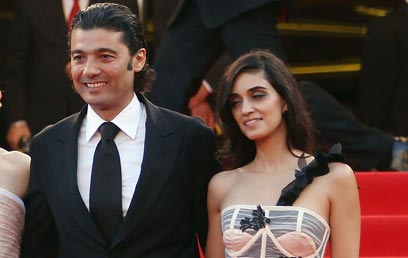
The head of Egypt's Actors Guild, Ashraf Zaki, has decided to launch an inquiry against Egyptian actor Khaled Nabawy for "normalization with Israel" over his role in Doug Liman's American film "Fair Game" alongside Israeli actress Liraz Charhi.

Nabawy was criticized by Egyptian officials after being photographed embracing Charhi on the red carper during the Cannes International Film Festival, where the movie has its world premiere and took part in the official competition.

The different professional associations in Egypt forbid any type of normalization with the Jewish state and strongly condemn any association member who challenges this demand.

Charhi and Nabawy at Cannes (Photo: Getty Images Bank)

Zaki told a London-based website that he would meet with Nabawy this week and inquire whether he knew in advance that Charhi had an Israeli citizenship. If Nabawy is found guilty, he is expected to be suspended from the association for a long period of time.

Arab websites that reported the affair noted that Charhi was "an Israeli actress of American descent, who served in the army for two years before turning to acting and appearing in a number of American films."

Zaki told the Reuters news agency that he would bring the matter to the Actors Guild council in the coming days. "I asked to meet with Nabawy. After we meet, I will write a memo to the council so it can make a decision."

He refused to elaborate on the punishment Nabawy may face if he is found guilty.
 
 
Charhi: He knew he would pay a price
 
The Israeli actress involved in the affair told Ynet on Tuesday that "the picture of the two of us did not change anything. Nabawy already knew that he would pay the price for our cooperation on the screen.
 
"Even before he was cast for the role, there was another Egyptian actor who withdrew from the production after receiving threats that he would be dismissed from the association," Charhi added.

"At this stage I was certain that they would let me go. But then Nabawy arrived, a professional actor who came to work. When we met during rehearsal I noticed that he was a bit indrawn, and I waited a while before I approached him.

"I knew that it was all very sensitive, so I was very gentle. But during the filming period we became friends. We played a brother and sister, and it didn't seem strange to either of us.
 
"When they arranged the seats for the screening, they put us together and we both didn't mind. He didn't say anything when we stood together for the photo shoot. I was sure that they would be angry at him, but I didn't believe that they would launch a suspension procedure against him. I'm shocked.
 
"We saw this film as work, not politics, and hoped that seeing us getting along would convey some kind of message. But I never imagined that the voices against him would be so hostile," she concluded.

Friday, April 9, 2010

Ynet News: Israeli Arab authors banned from Lebanon festival

Two writers who won literary awards in Beirut will have to travel to London to collect their prizes because of laws in Israel, Lebanon

Associated Press Published: 04.08.10, 07:50 / Israel Culture

Two Israeli Arab authors who won literary awards in Lebanon will not be able to collect their prizes in Beirut later this month because of laws in the two countries, organizers of a cultural festival said Wednesday.

Instead of traveling to Beirut, writers Ala Hlehel and Adania Shibli will be going to London to receive their prizes there. The two are among 39 Arab authors to be honored at the Beirut39 Festival that starts April 15.

The ban was not unexpected – Lebanon prevents holders of Israeli citizenship from entering the country and Israel bans its citizens from visiting "enemy" states.

The two countries remain technically at war and have fought several battles in the past decades. Israel occupied parts of southern Lebanon for 18 years until it withdrew in May 2000. In 2006, a war between Israel and Lebanon's Hezbollah group left 1,200 Lebanese and 160 Israelis dead.

The four-day cultural event in Beirut celebrates fiction and poetry writers under the age of 40. It's organized by the Britain-based Hay Festival, a nongovernment group that fights for rights of writers, and the Beirut UNESCO World Capital of the Book 2009.

'Authors living under occupation'

Hlehel, 35, is acclaimed for his collection of short stories Al-Sirk, or The Circus, and a play. Shibli, 36, wrote the novel We Are All Equally Far From Love, and has published short stories and essays in literary magazines.

The regulations are so strict that Israeli lawmakers have gotten into trouble before for visiting Lebanon. Lebanon also bans travelers with Israeli stamps in their passports from entering the country.

Raquel Vicedo, project manager with Hay Festival, told The Associated Press the organizers knew from the start the two would not be able to make the festival and set up a simultaneous event, entitled Free the World, in London in which the two will participate.

Ghassan Abu Chakra, in charge of cinema, theater and exhibition at Lebanon's Ministry of Culture, said the two authors "are Arabs living under occupation and it is our job to help them."

"Adania and Alaa will be in London because, regrettably, we were not able to bring them to Beirut," said Joelle Rizkallah, also a project manager.

Hlehel, who was not immediately available for comment, wrote on his blog that he has petitioned Israel's High Court to travel to Beirut.

Tuesday, March 2, 2010

Ynet News: Israeli cricket wins Dubai prize


Anat Shalev Published: 03.02.10, 07:42 / Israel Culture

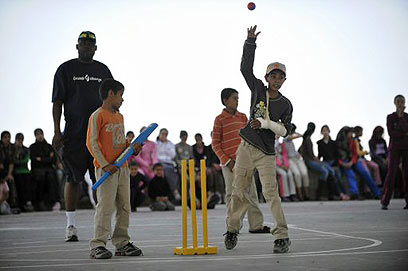
The Dubai-based International Cricket Council has awarded the Israel Cricket Association with a prize for a cross-border initiative bringing together Jews and Bedouins in the southern Negev desert.

The winning project was initiated by Stanley Perlman, the Israel Cricket Association's chairman.

Arabs playing cricket in southern Israel (Photo: Reuters)

The Association's director, Naor Gudker, who is also an international umpire, told Ynet that cricket is among the top three sports in Asia and in many Arab states, including Pakistan and Dubai.

"A very high percentage of the managers, players, and coaches in global cricket are Muslims," he said. "We do not feel that we are met with revulsion in Muslim states, such as Malaysia, where we played in 1997."

Gudker expressed his excitement over the latest award, which joins a similar prize won by the Israeli association in 2001.

"It's a huge achievement. It's a project we promoted that was warmly received across the world," he said. "This award in general and the project in particular are a good example of how cricket can bridge, bring compromise, and teach us to accept others."

The next move is to make cricket accessible to Arab Israelis in Israel's north, he said.

Gudker used the opportunity to criticize authorities for failing to offer cricket the support it deserves.

"Cricket is rather developed in Israel – there are 21 teams, school leagues, and youth leagues…in Beersheba, 2,000 kids are involved in projects related to the sports. Yet nonetheless, the State is unwilling to build a central cricket stadium and upgrade the sports to an international level," he said.

Wednesday, February 24, 2010

Ynet News: Jewish women of Bollywood cinema

Many of Indian cinema's stars came from families of Baghdadi Jewish descent who had been living in country for decades

Ilan Mester Published: 02.24.10, 07:51 / Israel Jewish Scene

Movie goers from Bombay to Bangalore were star stuck over Bollywood’s Sulochana during the golden age of Indian cinema. At the time, most of them were unaware that Sulochana was Jewish and that her real name was Ruby Myers.

But Myers wasn’t the only actress to light up the silver screen in India during the 1920’s and ‘30s. Rose Ezra and Farhat Ezekiel Nadira shared the Bollywood limelight along with other Jewish actors. They came from Indian families of Baghdadi Jewish descent who had been living in India for decades.

At the time, many Hindu and Muslim women weren’t allowed, for modesty’s sake, to appear in movies, according to documentarian Eric Molinksy. However, Jewish women were able to pursue careers as actresses in India.

They were able to play diverse roles. For example, Nadira was known for playing the “bad girl” and, for her strong screen presence. Most of the Jewish Bollywood stars reached their peak in the 1920s and 30s. However, many continued acting throughout their lives. Sulochana held her last film role in 1980, three years before she past away.

Reprinted with permission from Shalom Life

Friday, February 19, 2010

Ynet News: NY Times presents: Israeli cuisine course

Prestigious newspaper's online university introduces course on emerging Israeli cuisine in its study program

Sarit Sardas-Trotino Published: 02.19.10, 08:21 / Israel Culture

As part of an online project orchestrated by the New York Times, web surfers will now be able to educate themselves on the principles of the new emerging Israeli cuisine.

The New York Times Knowledge Network commissions journalists and academics from around the world to give paid online courses for the public on a variety of topics such as art, law, politics and science. The idea of introducing an Israeli culinary course was initiated by the Israeli Consulate in New York and constitutes the first culinary course in the newspaper's online university program.

For a sum of $145 students can take part in a three-part historical and cultural journey through the evolution of Israeli cuisine from ancient times until the present day. The course will address the unique confluence of cultures in Israeli cuisine, and will introduce, for example, couscous cooking methods and the recent gastronomical trends in Tel Aviv.

"This study program is part of a growing interest that the world and especially the US has been showing recently in our cuisine," says chief editor of Al Hashulchan (“On the Table") magazine Janna Gur who constructed the course.

"Sometimes I visit culinary schools in the US and at first the young chefs don't understand why they need to learn about the food in this faraway place called Israel. I explain to them that Israel is a fascinating case where one can observe in real time how a cuisine is born."

Gur also explained that Israeli cuisine is the result of the fusion of over 60 cultures. "We have a synthesis of flavors – chopped liver and Kneidlach have been mixed in with Mediterranean flavors together with local ingredients and international seasoning," she said.

'Israel a vegetarian heaven'

According to Gur, the Israeli cuisine has undergone tremendous changes over the last thee decades. "Our cuisine is very relevant for the present day since most of it is based on vegetables and vegetarianism is the new bon ton.

"Did you know that Israelis are the only people to eat vegetable salad in the morning? Indians consider Israel a vegetarian heaven."

Students of the online course will also get a chance to view Israeli star chef Haim Cohen prepare a meal based on signature Israeli dishes. "I'm glad that the Ministry of Foreign Affairs is promoting the country through food. Maybe if people saw we have this type of culture their hostility towards us would be diminished," he said.

Cohen also noted, "Israeli food is also based on the Arab cuisine. If we can't achieve comprehensive peace, at least we can have culinary co-existence."

Thursday, February 18, 2010

Ynet News: Peer rolls into Dubai semis

Israeli tennis star continues superb performance, set to meet Venus Williams next

Associated Press Published: 02.18.10, 21:20 / Israel Culture

A year after she was stopped from playing in the Dubai Championships, Israeli tennis star Shahar Peer is proving unstoppable in reaching the semifinals on Thursday.

Unseeded Peer beat her third seed in four matches when No. 8 Li Na, the Australian Open semifinalist, retired with back spasms. Peer was leading 7-5, 3-0.

Peer, who has also beaten No. 1 Caroline Wozniacki and No. 13 Yanina Wickmayer, will meet defending champion Venus Williams.

"I'm beating so many good players," Peer said. "It's really good and I'm happy by the way I'm playing. I think I'm playing very, very good, and everything is coming together. So I just hope to keep going."

'She's so brave'

Peer, who was been surrounded by security and played only on the most secure court at Aviation Club, earned the admiration of Williams.


"She's so brave and she's got so much character. I can't imagine being in her shoes," Williams said.

"I can't imagine playing so well with this kind of circumstance. I don't think anyone else on tour could do what she's doing."

Last year, Peer's visa was denied by the United Arab Emirates for security reasons, so the WTA Tour punished the tournament organizers with a heavy fine.

She's into at least the semifinals for the third time this year.

Wednesday, February 17, 2010

Ynet News: Peer beats Wozniacki to make Dubai quarterfinals

Israeli tennis star wins in Dubai Open upset against top-ranked Danish player, moves on to quarterfinals. Match court swapped out of security concerns

Associated Press Published: 02.17.10, 14:12 / Israel Culture

Shahar Peer upset top-seeded Caroline Wozniacki of Demark 6-2, 7-5 Wednesday to reach the quarterfinals of the Dubai Championship, a year after she was refused a visa to play in the tournament by the government.

The Israeli had at least one break opportunity on each of Wozniacki's 10 service games. She had never previously even taken a set off the 2009 US Open finalist in three previous matches.

Peer closed it out on her fifth match point in a second set that contained seven breaks. The third-ranked Wozniacki held serve only twice in the match.

"She played really well," Wozniacki said. "She kept changing the rhythm all the time. I had a few unforced errors early in the match and never managed to put her under pressure."

Last year, the organizers were fined $300,000 by the WTA for Peer being unable to play in the event after a visa was denied by the United Arab Emirates government, citing security reasons.

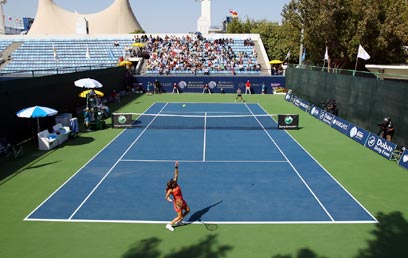
Wednesday's match was moved to Court No. 1 at the Aviation Club as it is the most secure, a decision Wozniacki agreed with even though she said the court speed was different.

"If there is a threat to her, there is a threat to me as well. So I completely agree with the fact that the match was scheduled on Court No. 1. I'd rather be safe than sorry," Wozniacki said. "The change of court did create a bit of a problem, since it was a little faster than the Center Court. But the conditions were the same for both of us and I really can't complain."

Both players traded breaks in the opening set before the 22nd-ranked Peer broke decisively to lead 4-1.

Wozniacki won 42 percent points on first serve and 37 percent on second.

Monday, February 15, 2010

Ynet News: Peer makes winning start to Dubai event

Israeli tennis star beats Belgian opponent in opening match at Dubai championships year after being denied visa to United Arab Emirates

Associated Press Published: 02.15.10, 20:55 / Israel Culture

Shahar Peer rallied to beat 15th-ranked Yanina Wickmayer of Belgium 3-6, 6-2, 7-5 in her opening match at the Dubai Tennis Championships on Monday, a year after the Israeli player had been denied a visa to the Emirates.

Authorities had cited safety reasons for preventing Peer from playing last year, with tournament organizers saying they feared fan anger over Israel's three-week military offensive in Gaza. Organizers were fined $300,000 by the WTA after denying her the opportunity to play.

Peer made a faltering start on Monday, being dominated by the Belgian’s power game from the baseline and twisting her ankle, before recovering in front of a small and courteous crowd at court No. 1 of the Aviation Club.

"There are a lot of emotions coming after this win. It's more than beating Yanina, it's more of me handling all the stuff around and able to put everything on the side and just play tennis, and just concentrate on the (match) and not the politics," Peer said.

"It was a lot of emotions for me and a really tough first round and I am so happy I was able to win this."

Police security was tight during the match, with several plainclothes policemen mingling with the crowd. Captain Eesa, head of security of the Championship, was personally present in the stand during the match.

Spectators had to pass through metal detectors and physical screening before making it to the court.

However, there were no untoward incidents during the match and although Wickmayer had better support, Peer received polite applause whenever she won points.

"I think the treatment I get from the people here is amazing, including the security. They are really kind, they are doing everything for me. Of course, there are a few restrictions," Peer said.

"But I am really enjoying my time here, and they take care nicely of me. It is fun for me, and whatever they do, they do it for my safety."

As for the early stages of the match, Peer admitted: "I started pretty bad. I was very frozen and I didn't move. I twisted my ankle on the second point and I was like 'oh my god, I don’t need this. Finally I’m here and on the second point I might go home'.

"I really wanted to win this match, not only because of tennis, but because I want to make a statement that politics and sport should not be involved."

Wickmayer, who had won both her previous matches against Peer, got off to a brilliant start as she raced into a 3-0 lead. But Wickmayer’s biggest weapon her serve failed her repeatedly after she closed the first set at 6-3 in 40 minutes and the momentum promptly swung Peer's way.

Taking on France next

Peer's next opponent will be France’s Virginie Razzano, who is two places below her in the rankings.

Peer also won her first round doubles match later in the day. Partnering Gelina Voskoboeva, she was involved in another tight match as they beat Anabel Medina Garrigues and Caroline Wozniacki 7-5, 4-6, 10-5.

The biggest upset of the day was Italian Tathiana Garbin’s three-set victory over ninth seeded Samantha Stosur of Australia. Garbin ranked 42 places below the world No.12, needed two hours and 21 minutes to win 3-6, 6-2, 7-6 (4).

Also making a quick exit was the 15th seeded Nadia Petrova. The Russian slumped to a 7-6 (5), 7-6 (5) loss to Swiss wildcard entrant Stefanie Voegele.

Tuesday, February 9, 2010

Ynet News: Rabin Museum: A fascinating history lesson

New exhibition provides visitors with impressive documentation of State of Israel's development and slain prime minister's biography, but requires a lot of patience and concentration

Sandy Livak-Furmanski Published: 02.08.10, 15:18 / Israel Culture

The Israeli Museum at the Yitzhak Rabin Center has opened to the general public, offering visitors a fascinating documentation of the State of Israel's history, interwoven into the story of the slain prime minister's life.

The museum focuses on historic milestones in Yitzhak Rabin's life and connects them to turning points in the State's development.

Upon their arrival, visitors receive individual audio devices – offered in Hebrew, English and Arabic – allowing them to tour the exhibition at their own pace and view dozens of short films.

The tour begins in a round hallway with a three-minute clip of the night Rabin was murdered. Visitors then enter an inner corridor built on a downward spiral, which presents Rabin's biography, and can walk through rooms along the way presenting the State's history up to the assassination on November 4, 1995.

The exhibition ends in another spiral hall with several screens presenting short clips from the announcement of Rabin's murder, through the reactions of the Israeli public and international leaders, to the funeral and eulogies.

The museum is built in a way which makes it difficult to miss any of the exhibits, and visitors can spend over three hours exploring more than 180 documentary films and 1,500 photographs, as well as hundreds of memorabilia.

One of the most unique exhibits is Rabin's study at his Tel Aviv home, which was moved to the museum intact, just the way it was before he left for the peace rally in which he was murdered, including a TV broadcasting the same soccer match the prime minister was watching that day.

Saying that the museum glorifies Rabin would be an understatement. A large part of the exhibition is devoted to his second term as prime minister and includes a wall filled with television screens documenting the economic growth and educational reform which took place during that period, as well as quotes from citizens praising the changes in Israel's road system.

It should be noted, however, that the academic team appointed to determine the museum's content did not ignore the not-so-pleasant chapters in Rabin's biography, like his 24-hour collapse when he served as IDF chief of staff during the Six-Day War and his decision to resign during his first term as prime minister due to his wife's illegal US dollar account.

A visit to the Yitzhak Rabin Center's museum is an interesting experience, but the exhibits are often overwhelming due to the large number of items and require a great deal of patience (and a comfortable pair of shoes). The audio devices are an integral part of the visit, but the massive amount of short films is somewhat confusing.

Despite its shortcomings, this impressive exhibition provides an important history lesson for Israelis and foreign visitors alike.
___________________________________________________
The Israeli Museum at the Yitzhak Rabin Center, 14 Chaim Levanon Street, Tel Aviv.

Opening hours: Sunday, Monday, Thursday – 9 am–5 pm; Tuesday – 9 am-7pm; Friday – 9 am-2 pm

To schedule a visit, dial 972-3-7453358

_