Showing posts with label Cuisine. Show all posts

Tuesday, August 2, 2011

Israel Land of Shalom. Impressions written by "D"

Preface

Despite the "Friendship prior Peace" website is closed since a few months, I'm very pleased for the opportunity to publish a very special trip report of "D" (the name is kept "D" for confidentiality reasons). I was very surprised by D's tour to Israel. I couldn't manage to meet D face to face due to the very short notification, but I managed to call D and we have a phone conversation before leaving Israel.

I could hear in D's voice during our conversation his satisfaction of visiting Israel, even it was very short. I asked D to write his impressions from his visit and I'll be more than happy to publish it on "Friendship prior Peace" even the web blog is no longer active. I want to thank deeply from my heart for his dedication and time to compose his impressions for the benefit of anyone who reads this blog.

Hanan Leshnovolsky
_______________________________________________________

Israel Land of Shalom

Written by: "D"

In the last year I had been thinking about visiting my Malaysian uncle's homeland. I was blessed with the opportunity to go in July. I had made quite a few entries on Friendship Prior Peace Blogspot and i wanted to experience the Holy Land for myself. I just return from Israel after a week.

It is my hope to share my trip and experiences of going to Israel, Good and Bad.

Three hours before boarding El Al the security check-in staff arrived with four music stands. They proceeded to screen the people in the line. My screeners put me through a long winded interrogation. At one point I was introduced to the El Al Chief Security officer, another El AL Senior Officer along with an EL AL Junior Officer. All my luggage was screened for explosives and i got a full screening for bomb residue. I felt uncomfortable and understand how Muslims feel when they think they are being singled out at Airports. Finally, I was allowed to board the plane.

The attendants on El Al flight were cordial. I was still a little unbalanced. Upon arriving in Tel Aviv I felt much better. Tel Aviv is a very dense city with an interesting milieu of Jewish cultures. People were very friendly in helping me navigate to my Hostel. One Israeli had his GPS on his IPhone directing me as we approached my bus stop. Tel Aviv is hot and humid but to my surprise no mosquitoes.

Tel Aviv never sleeps and has an active 'disco-disco' nightlife. Walking the beach my first night. There were lots of people swimming around. Several food kiosks and promenade with local bands playing music. Lots of interesting music.The Mediterranean ocean is actually warm. Not your Pacific ocean type coldness.

The most interesting sight was Religious Hebrews dancing on the sidewalk and on a busy street with very interesting tunes and handing out brochures to locals.

Tel Aviv Gordon St Shabbat


Religious Hebrews Dancing


Tel Aviv Beach

Jerusalem the cradle of the Abrahamic religions Christianity, Islam and Judaism is like a city within cities. Jewish, Islamic and Christian sections within the City squeezed together like sardines. The Jewish quarter has the newest buildings which were rebuilt after the Jordanians demolished most of the site in the 1967 war. Interestingly, there is a tiny Mosque in the middle that was untouched and preserved by the Israeli's. There was a Jewish family that had converted to Islam and donated their small house which the Mosque was built on. That is why there is a tiny minaret next to a huge Synagogue in the picture. Of course the Wailing Wall is the most prominent site for the Jewish Religion. People come to pray and write their wishes on paper which is inserted into the wall. In Jerusalem we passed by multiple Holy Sites including the Dome of the Rock, Al Aqsa, Holy Church of Sepulchre, Church of Gethsemane and others. Jerusalem itself is a smorgasbord for archeologists. Even outside the Old City I saw archeological remnants everywhere. An unknown tomb of a wealthy jewish remnant recently discovered by Hebrew University, ancient jewish tombstones hundreds of them on the slopes. You could probably excavate everywhere around Jerusalem and find something there.

Garden of Gesthemene


Garden of Gesthemene


Jerusalem Overview


Jewish Tomb

Al Aqsa


Mosque and Synagogue


Wailing Wall


Wailing Wall Tunnel

Touring Bethlehem and Jericho I got to experience the security wall. Let me describe it as best I can. Firstly, it is not possible to make a value judgement from the brief period crossing the wall. However, i can tell you what i saw and what people I’ve talked to say about it. In order to cross into East Jerusalem you must pass through the wall from Israeli to Palestinian control areas. The wall is intimidating to say the least. Tall with sensors,cameras and barbwire. You cross by yourself through a narrow corridor and pass through a checkpoint where an IDF soldier in a booth checks your identity (Passport). He waved us through. I saw Arabs/Palestinians pass-through using finger print hand scanners. The soldier was respectful and did not question us or stop any persons. Passage was quick without any issues. There weren't any crowds on both-sides as expected because it was on a Shabat (Saturday). We met our Palestinian guide Sam on the other-side. Sam described the wall and hardship it had caused to the Palestinians. Travel has become a difficult daily occurrence. You must have permission and biometrics (hand) coded. There is apparently a curfew period of when you can cross and return, as well as, restricted passage once you cross into the Israeli side i.e. proof of work and path you are allowed to take to work. I wondered if the security wall was necessary ? Speaking with Rachel the night clerk at the Hostel later. I realized the motivation behind the wall. Before the building of the wall. The last Intifada resulted in many deaths as a result of a slew of suicide attacks. The daily occurrence sometimes twice a day lead to the building of the wall. Israeli parents stopped sending their children to school and there was a paranoia about taking public transportation or being in public places. My feeling is the wall should be taken down as soon as possible when both sides come to a mutual agreement.

Message bodyMary’s' Grotto, Sheppard’s Field and the Church of the Nativity were the highlights in Bethlehem. As a Christian city, Bethlehem's Christian population is dwindling. It will be a sad day if the community ceases to make a presence in the place of Jesus's birth. We had to go through two road checkpoints between Israeli and Palestinian control areas. Again, IDF soldiers were respectful and cordial. They chatted with our bus driver in a cordial tone. There were no concerns as tour guests on the bus. They waved us through quickly. Israeli IDF conscripts are a mix of youthful and senior ranks. It seems to me the media, at least in the West likes to show clips of aggressive IDF soldiers but it is not what i observed. Jericho is believed to be the oldest city in the world. It is 244m below sea (lowest point) level and therefore a natural spring as the water table sits beneath the city. It is amazing as you see a water fountain springing out in the middle of the Judean Desert at 42C. We passed through a Palestinian checkpoint. They were cordial and waved us through. We had lunch at mall and got to view archeological remnants.

Border crossing


Border crossing

Marys Grotto

Sheppards Field Display

Jericho Spring


I enjoyed the Dead Sea and Masada tour the most. For several reasons. I travelled to Israel with knee problems. I have an old work injury on my right knee acts up once in a while. My muscles lock up and prevent me from bending. So I use a cane or brace when it acts up. Also, my feet were irritated from walking on the beach in Tel Aviv and my scratching didn't help. The Dead Sea apparently helps blood circulation and is good for your skin especially with skin disorders like psoriasis. I was reminded of the biblical narrative of Namaan and the Jordan River. At the beach you apply mud on your skin for treatment and immerse yourself in the dead sea which is full of salts and minerals. It disinfects your body and permeates through your body. After two hours of soaking and rinsing. I felt relaxed and my the muscles in my knee loosened up. The skin irritation went away. It really helped my blood circulation. At least, for me i had full movement in my knee.

Masada is a symbol of Jewish 'Chutzpah' (Audacity). It was the last stronghold that the Romans (10th Legion) sieged. The siege lasted 3 years whereby the Romans built a seige ramp using Jewish slaves at Masada. Zealots held out in defiance until it became apparent that Masada would be bridged. Preferring death before slavery. 10 men were chosen to complete the task of killing the tribe leaving one to kill the 9. Today Israeli Soldiers take an oath in remembrance of Masada. It is also a popular place for Bar Mitzvah's. How did the Zealots survive on top of a mountain for 3 years? An ingenious method of ancient engineering. Aqueducts were carved on the mountain sides to collect rain water from the mountains that were directed into carved cisterns. They also built a bath-house, food (Dried Fruits) and fuel storage (Olive oil). Infact, Masada was one of Herod's palaces.

My tour Operator Mr. Manashe reminded me of my uncle. I really liked him and told him he reminded me of my uncle at the end of the tour. Here he is feeding an Israeli (Tristram’s Grackle) bird by hand. The bird actually flies onto your hand and picks the food out your hand. On the topic of animals. I love the cats in Israel. They are so mellow. I find them so pleasant to look at and they like to pose for pictures. They're not well groomed but short-haired cats. Israeli's love their dogs you see them jogging and cycling with their pets everywhere. They even bring them into restaurants. At a Pizza Hut restaurant I spoke to a Israeli with her old blind dog. I asked about the cats. She mentioned that most of them are strays.

Aquaduct Model


Aquaduct


Cistern Reservoir


Mr. Manashe Feeding Bird


Masada


Israeli Cats

My favourite Felafel and Donair eatery is north of Gordon St along Dizengoff St. The donair meat just melts in your mouth.I love the lemonade as it goes down well on a hot day. My last night was spent walking the beach in Tel Aviv to Old Jaffa. I had stumbled across a large crowd of Israeli Jews, Arabs etc having a night out barbequing. I was amazed by the people barbequing 'kabobs'. It smelled so good. They use tiny BBQ (tray sized) Charcoal Briquettes. I wanted to go over and ask for some. The whole pathway along the beach smelled of Kabobs I ended up walking to Old Jaffa (old quarter) with all the castle like buildings. At one location it looked like an abandoned building but loud screeching sounds permeating from the inside. To my surprise looking through the door gate there were hundreds of bats clinging to the ceiling, flying back and forth.

BBQ Kebab


BBQ Kebab


Donair Eatery


Old Jaffa


Old Jaffa

Dead Sea


Dead Sea shore


Judean Desert Sea Level


The flight back was much more relaxed and security at Ben Gurion went much smoother. I found that Airport Security were very respectful and cordial unlike my maiden voyage from Canada. El Al Attendants were very much more relaxed and pleasant. They paid special attention to the children on the flight. Israeli's have a deep deep love for their children. It is apparent when you see them holding and hugging them. They are like little treasures that cling to their hearts. Perhaps it is because as a society they've experience suicide attacks, rocket attacks or fighting so many wars that make them dote their children so much. One thing i noticed about EL Al flights, credit to the pilots. The horizontal pitch at cruising altitude was very steady and comfortable.

As a land that is steeped with religious traditions. I felt a peace and tranquility in Israel. My daily prayers were for the Peace of Jerusalem. Protection for Israeli's (Arabs, Jews and Christians) from the front, back and sorround her with Yahweh's divine presence.

Israeli child


Israeli Mall


Ben Gurion Airport

Monday, April 5, 2010

Ynet News: Why do Israel's Arabs like eating matzot?

While most Jews in Israel reluctantly eat bread-substitute during Passover, many Israeli Arabs take a genuine liking to Jewish wafer

Associated Press Published: 04.05.10, 08:08 / Israel Culture

Many Jewish Israelis can't stand the stuff, so there's something mind-boggling about their Arab compatriots: Why in the world do they choose to eat matzot?

Despite decades of uneasiness in their coexistence with the Jewish majority, Israel's Arabs have developed a love affair with matzot, the dry, crunchy wafers that observant Jews eat as a substitute for leavened bread during the weeklong Passover holiday.

Weeks in advance, Arab-owned stores across Israel stock up on matzot, knowing their customers will clean it out.

Matzot. Substitute for leavened bread
Photo: Visual Photos

The matzot craving among Israel's Arab citizens - about 20% of the population - reflects their ambiguous place in the Jewish state. While they speak Hebrew, carry Israeli passports and wear Israeli brands, many say they suffer discrimination and identify themselves as Palestinians.

Still, they love matzot.

"We eat it from the start of the holiday to the end, and when we run out we buy more," said Umaima Igbaria, a 35-year-old Muslim woman who lugged a carton of matzot out of a supermarket in the Arab town of Umm el-Fahm in northern Israel.

She said she, her husband and their three sons all eat matzot, usually with tea and slathered with chocolate sauce. She said they didn't care if it was "Jewish food."

Inside the store, a 5-foot-tall (1.5-meter-tall) stack of matzot boxes stood in the entryway, all that remained of the more than 4 tons that owner Tariq Ifin ordered for the holiday, which began Monday night. He had no doubts the rest would sell.

'Part of the holiday'

In the Passover tradition, matzot commemorates the biblical story of the Jews fleeing Egypt so quickly they had no time to let their bread rise. Jews also consider matzot poor man's bread, eaten to remind them of their ancestors' hardships. Few consider it a culinary delight.

"I don't like it much, but it's part of the holiday," said Simon Mizrahi, 44, an observant Jew from Jerusalem who eats his matzot with soup, cheese or butter.

Mizrahi said matzot doesn't fill him up like bread, and he worries its carbs will make him fat. Many other Jews share his ambivalence, recognizing its traditional role while saying they get tired of it.

To prevent matzot burnout, many have developed alternative recipes. Some stir crushed matzot into warm milk or coffee to make porridge. Others add an Italian twist, topping it with tomato sauce and cheese to make matzot-pizza or substituting it for noodles to make matzot lasagna, or "matzagna."

Outside of the holiday, few eat it and few stores stock it. Many say they wouldn't eat it if they had other options.

Thus their surprise when informed that Israel's Muslim and Christian Arabs - who don't observe Passover and can eat any bread they like - choose matzot.

The answer to the mystery is simple, said Arabs in several mainly Arab towns in Israel. They just like the taste.

"The kids love it. They eat it like cookies," said Wisad Jamil, a 43-year-old woman lugging a carton of matzot and tub of chocolate spread to her car for her husband and five kids at the Umm el-Fahm store.

"Don't the Jews eat our bread? Fine, we eat their matzot," she said.

Indeed, the mixing goes both ways, with Arab dishes like hummus and felafel now favorites of Jewish Israelis. And during Passover, nonobservant Jews often turn to Arab shops for leavened bread, which disappears from most Jewish-owned stores in the season.

Ifin, the supermarket owner, said some of his Arab customers once refused matzot on ideological grounds, though fewer do now because of years of mixing.

"You can't say Arabs and Jews are one people, but we share the same land, so why not share the same food?" Ifin said.

Palestinian kinship

While Israel's 1.5 million Arabs hold citizenship and vote in elections, they strongly identify with their Palestinian brethren in the West Bank and Gaza Strip. Most still call themselves Palestinians.

Palestinians in the territories and east Jerusalem largely don't share the matzot craze, and shops there don't sell it. Israel captured the predominantly Arab east Jerusalem in the 1967 Mideast war, and Palestinians claim it as the capital of their future state.

"We don't like anything that comes from them," said Jerusalem taxi driver Firas Salem, 27, when asked if he ate matzot.

"And besides," he said - expressing a sentiment shared by many Jews - "bread tastes better."

Sunday, March 28, 2010

A "Gefilte-Fish" Passover greeting from "Manggis Malaysia"

Happy Passover to All Jews (my friends and my enemies)

Special Passover Greetings from me, a Malaysian Malay Muslim especially to my dear friend Hanan and his family.

Hanan told me a special Passover recipe typical of the Ashkenazi Jews, a Yiddish recipe, a super Jewish tradition called the Gefilte Fish. Here is the video link which shows how to make this dish http://www.videojug.com/film/how-to-make-gefilte-fish
Jewish Traditional Gefilte-Fish served during Passover

It really looks delicious to me. I love food and enjoy any types of food from all over the world and of different cultural varieties. I told my doctors that I have one illness only, i.e. I like to eat. This is my sin.

I love also fusion foods, i.e. food made from the fusion of different cultural recipes and these are so common in Malaysia, for example I love to eat the Italian spaghetti bolognaise (spaghetti in meat ball sauce) with sambal belacan (a special very hot prawn paste chillie sauce). I know some races including Jews, Iranian and Arabs (the Smetic people) do not allow meat and fish to be eaten together but I never know why.

This is how I would eat my spaghetti bolognaise with sambal belacan

My favourite foods are those from the Indian culture. I like the extreme flavour of spices and the combination of these, which make new flavours.
Aaahhh! Food, glorious food!

Recently, with the influx of Iranian people into Malaysia, I began to like Iranian foods as well. I am yet to learn how to prepare good Iranian dishes, but not to worry, there are now many Iranian restaurants in Malaysia.

On this Passover, Hanan has made this gefilte fish for his family and he invited me over to his house. Thank you Hanan, inshaAllah, I would drop by someday to enjoy your special recipe, apparently handed down from his mother. Otherwise I can join you online. I can “share” your e-gefilte-fish since we are supported by online multi-media from digitized clours (RGB) technology. But unfortunately I will not be able to smell or taste it electronically. I was discussing with Hanan on the possibility of digitizing smell and taste. I am sure it can be done. We need to look for the primary and standards. Although there are already efforts to digitize smell, I have not found on digital taste bud.

Left is matzo bread and right is chapati.

Before all that technologies made possible, perhaps I could try to make gefilte-fish myself. Looking at the video, it does not look all that difficult. These are quite similar to fishballs except it is difficult to get the “matzah meal” here since it is the crumbs of a special unleavened bread/biscuit Jews would take during the Passover. However, I was told this could be substituted with “chappati bread crumbs”. Emm, I shall try that. As for the fish, we have plenty of white fish, like jenahak, kurau, tenggiri and senangin, these are equally delicious white fish, to cook any which way, their meaty tasty fishy flavours are superb.

However, being a Malaysian and Malay myself, my taste buds are rather too spoilt for extreme taste. I would be tempted to add more spicy ingredients to this authentic Jewish recipe. Therefore, pardon me, may I suggest some modifications to this recipe to suit our Malaysian taste buds. Here are some of those variations to gefilte-fish Malaysian style. I use videojug recipe as the base recipe for 1kg fish meat.

1. Gefilte-fish with coconut

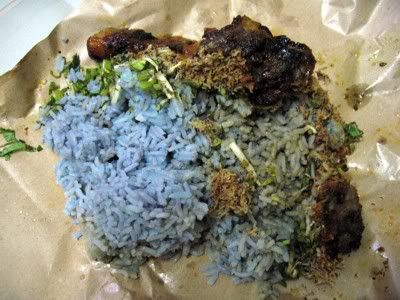
For this variation, just add 100g of grated coconut instead of matzoh meal. The rest of the recipe remains the same. The taste of coconut is rich and makes the fish taste better. Our Kelantanese culture (Kelantan is one north eastern state of the Malay Penansular) has a similar kind of fish ball with coconut stuff in chilli (solok lada), which is served with their nasi kerabu (the only “blue salad rice” in the world). May be, just may be, a long time ago, some Malayan Jews had introduced gefilte-fish recipe to a Kelantanese who later modified it with coconut because he could not get the matzoh meal. Nasi kerabu (blue rice salad) usually eaten with solok lada (on right).

2. Gifilte-fish with basil (daun selasih) and tamarind (asam jawa) sauce

For this variation, the preparation of the fish remains the same, but the sauce is modified by adding a bunch of fresh basil leaves (daun selasih) and a tablespoon of tamarind juice to the pot while boiling the sauce. Daun selasih or basil leaves (left) and tamarind paste (right).

3. Gefilte-fish with spicy sauce (the not so hot version)

For this variation, the preparation of the fish remains the same, but while preparing to boil the sauce, add a tablespoon of coriander, 1 teaspoon of fennel seed (jintan manis) ,1 teaspoon cumin (jintan putih) , 3 cloves (cengkih), 3 cardimons (buah pelaga), and an inch of cinnamon (kayu manis). This will modified a bit the taste of the sauce to the alluring taste of Indian spices.
See if you recognize these spices (fennel, cardamons, cumin, coriander. cloves and cinnamon).

4. Gefilte-fish with hot-spicy sauce

For this variation, just add a lot of hot pepper to the sauce. To make it chanllenging, add small pepper (cili padi), bunga kantan and daun limau purut (kiffir lime leaves). This variation will transform the gefilte-fish into the hot tom-yam Siamese style, wow!
Traditional Siamese tom-yum soup; gefilte-fish in a tom-yum may be delicious.

5. Gefilte-fish with santan (coconut milk)and lemon grass (serai) sauce

This variation will blend the gefilte-fish with the authentic Malay style cooking. Add lemon grass at the beginning of boiling the sauce. When this sauce is read filtered, add coconut milk and simmer it further for another 15 minutes.

There you are, my Passover presents, 5 different varieties of gefilte-fish recipe to try for the future Passover (too late for this year).

In the tropical countries, as with our climate which support mega diversity, we (tropical people) love varieties and variations, and these include our tendency to change traditional cooking recipe. But knowing Hanan and the Jewish tradition (he coaches me on this) the close and exclusive nature of the Jews may take offense on breaking their great tradition. Therefore, I beg you pardon a thousand pardons, if these recipe variations seem to adulterate the original super tradition of the gefilte-fish. It is only a recipe.

Although at the beginning, I greeted to both my Jewish friends and enemies. I do not really have any Jewish enemy. It is only a figurative speech on my part to attract audience, a cheap advertisement trick. However, I do know, some Jews really hate the Muslims. Therefore, here I am appealing to these people at least to review their thinking and outlook. As I write these down, I also realize, there are some Muslims who hate the Jews to their bones, to them I also make an appeal (if they read this article), to change their attitude. There is nothing to fight, really.

Wassalam. Friendship first!

p.s. Happy Passover to D, forgive me I have not reply to you, since I have been extremely busy. I will one day.

By Manggis Malaysia


Thursday, March 11, 2010

Ynet News: Traditional challah recipe

Get ready for Shabbat with some traditional braided bread

Jewish Recipes Published: 03.11.10, 08:20 / Israel Culture
Braiding challah Photo: Yaron Brener 
Ingredients
  • 5 pounds flour
  • 2 ounces fresh yeast and 1 package dry yeast
  • 2 cups warm water
  • 1 1/2 sticks margarine
  • 2 1/3 cups boiling water
  • 2 tablespoons salt
  • 1 1/2 cups sugar
  • 5 eggs
Glaze
  • 1 egg, beaten
  • Poppy or Sesame seeds
 Method
Dissolve yeast in 2 cups warm water in a small bowl, until it bubbles. In a large bowl, place margarine and pour boiling water over it and stir until margarine is melted. Add salt and sugar. Let cool for a few minutes and beat in eggs. Add the bubbling yeast. Gradually add flour. Knead for 10 minutes. If dough is too moist add a little more flour. 
When ready to rise, sear top of dough with oil, cover and let rise 1 hour. Separate a small portion of dough known as 'challah" from the whole dough. Shape and let rise another hour.
Brush with beaten egg to glaze. Sprinkle with seeds.
Bake at 350°F degrees for 1 hour for large challahs and 1/2 hour for smaller challahs and rolls.
Reprinted with permission from Shalom Life

Monday, March 1, 2010

The Jewish Bagel recipe


picture and recipe by www.bagelrecipes.net
Ingredients:


4 ½ cups of flour.
2 packets of active dry yeast.
1 ½ cups of water, at 110°F.
3 tablespoons of sugar.
1 tablespoon of salt.
1 gallon of water.
1 tablespoon of sugar.

Preparation Instructions:

  • In a suitably sized bowl combine 1 ½ cups flour and the two packers of yeast.
  • Combine the 1 ½ cups of warm water, 3 tablespoons of sugar and salt; thenp our over flour mixture.
  • Beat at low speed for about thirty seconds, scraping sides of bowl constantly.
  • Beat for three minutes on high speed.
  • Stir in as much of the remaining flour as you can mix in. Turn out onto a lightly floured surface.
  • Knead in enough remaining flour to make a moderately stiff dough. Continue kneading until smooth and elastic; then cover and allow to rest for fifteen minutes.
  • Cut into twelve portions; then shape into smooth balls. Punch a hole in the middle of each with a floured finger. Pull gently to enlarge hole to about two inches.
  • Place on a greased baking sheet; cover; and allow to rise for twenty minutes.
  • Broil five inches from heat for about 90 seconds on each side.
  • Heat 1 gallon water and 1 tablespoon sugar to boiling; then reduce heat.
  • Cook bagels, about five at a time, for 8 minutes, turning once in the middle.
  • Drain and place on greased baking sheet.
  • Bake at 400°F for 25 minutes.

Sunday, February 28, 2010

Ynet Lifestyle: Hamantaschen, a healthier alternative

In honor of Purim, here's a great recipe for holiday's traditional treat

Shalom Life culture staff Published: 02.28.10, 14:53 / Israel Culture

Purim's here, so we thought we'd give you a healthier alternative for this holiday's traditional treat - Hamantaschen!

Cookie:
4 cups whole wheat pastry flour
2 tsp. baking powder
1-1/4 cups sucanat
16 tbsp. canola spread
4 eggs (or substitute)
A little vanilla

Filling:
Chopped apricots (or prunes)
Honey
Sucanat

Method:
Mix together dry ingredients and add canola spread, mix really, really well. Add vanilla to beaten eggs and add to rest of mixture and knead.

Cook filling ingredients together with some water.

Roll out dough and cut into circles (with glass or better yet a tuna can with both the top and the bottom removed) stuff with filling and bake on parchment-lined sheet for most even baking) at 325°F on middle rack until brown.

With the use of unrefined sugar and flour, canola oil and egg substitute, there is no need to feel guilty enjoying this tradition fare. And, to make you feel even better, they are high in fiber and low in fat and cholesterol – unlike traditional recipes.

Tip:
Feel free to replace sucanat, with using unrefined turbinado sugar (raw sugar) only.

Reprinted with permission from Shalom Life

_